

Embodied Processing in dying, death, grief, and loss.
There is a moment when grief enters the body. The chest tightens. The breath shallows and recedes. The ground feels less certain beneath our feet. For those of us who sit at the bedside of the dying, as death doulas, death walkers, and counsellors, we come to understand that death is not only a psychological or spiritual passage, but a profoundly embodied one. It is important to note that any loss or change in our life can feel like a death of sorts, so this article can be read with that in mind. Maybe a relationship is ending, maybe a career is ending, maybe you have lost your home or your place in your country of birth... all these endings can be sat with in a similar way, as we sit with the end of life.
In my work as a death walker and holistic counsellor, I have learned that the body does not lie about death. It trembles, resists, softens, opens, collapses, and sometimes astonishingly finds peace before the final transition. This is where somatic techniques become not just useful, but essential.
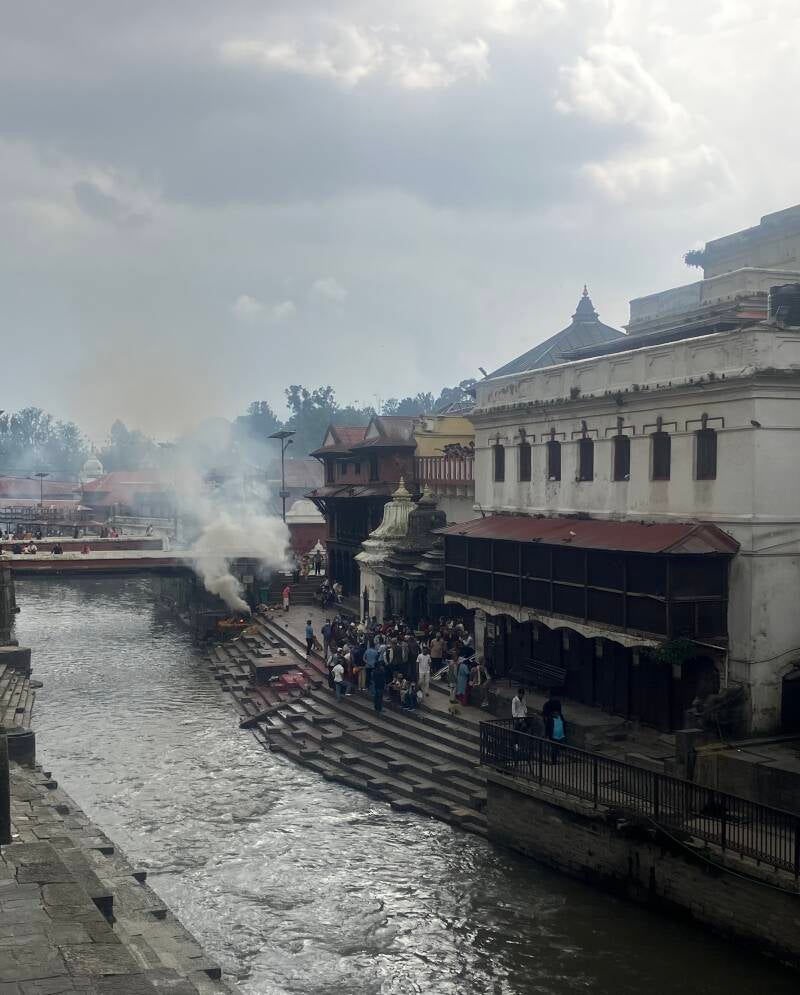
Image: open cremation, Pashupatinath, Kathmandhu, from my 2023 visit.
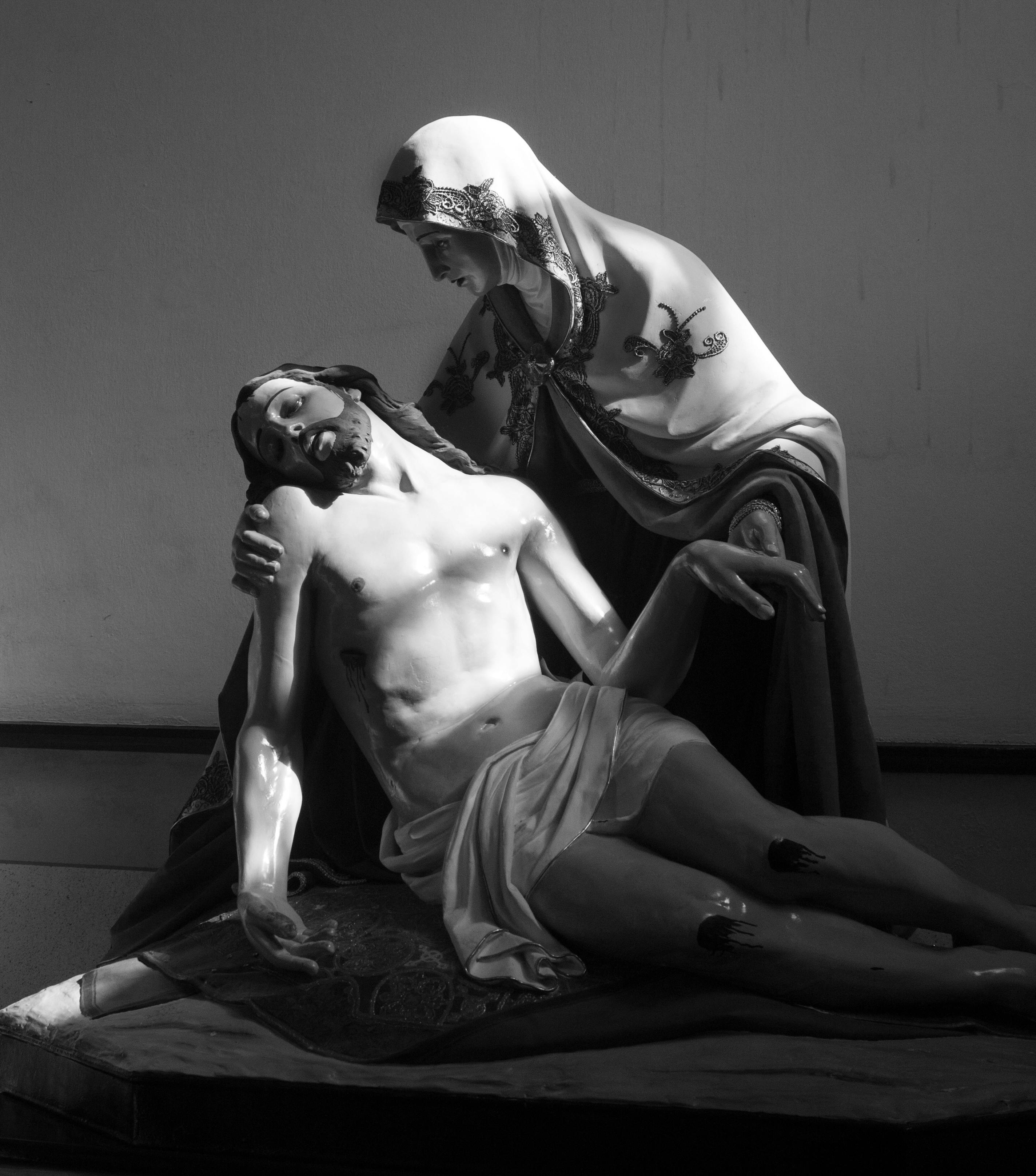
Death is a Process, Not an Event
Much of Western culture has treated death as a singular moment, the final breath, the stopped heart. Yet both ancient traditions and modern grief theory suggest otherwise. Death is a process, unfolding in stages, waves, and layers.
Elisabeth Kübler-Ross offered a framework that has become widely known; denial, anger, bargaining, depression, and acceptance. While often misunderstood as linear, these states are better understood as movements; energetic, emotional, and somatic currents that pass through us. In the body, denial may feel like numbness or dissociation. Anger may burn in the jaw, fists, or gut. Depression may weigh heavily in the limbs, making even small movements feel impossible.
Similarly, The Tibetan Book of the Dead describes transitional states, bardos, where consciousness moves through phases of dissolution and re-emergence. Though rooted in spiritual cosmology, these descriptions mirror what we often witness somatically; disorientation, release, contraction, expansion.
Both perspectives point to a shared truth. Dying, like grieving, is not static. It is dynamic, embodied, and deeply relational.
Dying, Terminal Illness, and the Body Unfolding
When someone is living with a terminal illness, the process of dying often begins long before the final days. There may be cycles of decline and stabilisation, hope and despair, clarity and confusion. The body becomes a landscape of changing sensations, capacities, and thresholds.
Fatigue deepens. Appetite shifts or disappears. Pain may arise and recede in waves. The nervous system can move between activation, fear, restlessness, agitation, and collapse or withdrawal. For some, there is also a surprising emergence of spaciousness with moments of stillness, reflection, or even quiet acceptance.
Somatic support at end of life does not aim to override these experiences, but to meet them with care and attunement:
- Supporting regulation amidst uncertainty: gentle grounding through touch, voice, or orienting to the environment
- Working with pain somatically: helping distinguish between physical sensation and the additional layers of tension or fear that can amplify suffering
- Honouring limits: recognising when the body is asking for less stimulation, less conversation, more quiet
- Facilitating expression: allowing emotions such as fear, anger, and grief, to move through sound, breath, or small movements
Importantly, the body often begins to let go in ways that are not linear or predictable. There may be moments of lucidity followed by withdrawal, or a sudden surge of energy before further decline. Rather than interpreting these as contradictions, somatic awareness allows us to stay with what is actually happening, moment by moment.
For those facing their own death, bringing attention to the body can sometimes offer a sense of agency within a process that otherwise feels uncontrollable. Feeling the breath, sensing contact with the bed, noticing warmth or the presence of another… these can be anchors in a rapidly changing inner world.


The Body as the Home of Grief
Grief is not something we ‘get over’, resolve, or complete. It does not have a clean endpoint, nor does it ask us to leave anything behind. Instead, grief becomes something we live with, something that changes shape as we do.
From a somatic perspective, grief lives in the body not only as something to move through, but as something we gradually make space for. Rather than metabolising it entirely, we grow with, through and around it. The nervous system learns, over time, how to hold both sorrow and aliveness, both absence and ongoing connection.
In the early stages, grief can feel like a totality, even overwhelming and hopeless. Tight in the chest, hollow in the belly, heavy in the limbs, it can narrow perception and reduce the world to the fact of loss. Somatic work does not rush this or try to transform it into something more palatable. Instead, it supports the capacity to be with what is here, while slowly, gently expanding the field of experience.
Some foundational somatic practices in grief work include:
- Tracking sensation: Gently noticing physical experiences… tightness, heat, trembling… without needing them to change
- Pendulation: Allowing awareness to move between grief and moments of relative ease, not to diminish the grief, but to widen capacity
- Resourcing: Sensing into support/resourcing, whether internal or external, that can coexist alongside the pain
- Breath awareness: Following the natural rhythm of the breath as it shifts with emotion
Over time, something subtle begins to happen. The grief does not disappear, but it becomes more spacious. There may still be waves on anniversaries, memories, unexpected moments, but these move within a system that has more room to hold them.
This is not about closure. It is about continuity and capacity.
Grief, in this way, becomes an ongoing relationship. Not only with the person who has died, or the relationship that has ended, or the home that has been lost, but with a part of ourselves that has been changed by loving them/it.
Sitting at the Threshold
As a death walker, I have sat with people approaching death. There is often a profound intelligence in how the body lets go.
Breath patterns change, sometimes erratic, sometimes deeply rhythmic. Muscles soften. The senses withdraw. What appears from the outside as decline can also be understood as a kind of inward turning.
Somatic presence at this threshold is not about fixing or intervening. It is about attunement.
- Matching the pace of the dying person’s breath
- Offering grounded touch, when welcome
- Noticing subtle cues: a furrowed brow, a relaxed jaw, a shift in temperature
- Supporting the environment to feel safe… dim light, quiet, familiar sounds
In these moments, the counsellor or support person’s own nervous system becomes an instrument. Our ability to remain regulated, present, and open can help co-regulate the person who is dying.

Grief as Continuation of Relationship
After death, the work of the body continues.
Grief is often described as longing, but in the body it can feel like searching, an impulse to reach, to call out, to orient toward the person who is no longer physically present. This is not pathology. It is attachment expressing itself somatically.
Rather than encouraging clients to ‘let go’, embodied approaches often support a renegotiation of relationship.
- Where do you feel the emotion for your loved one in your body, if anywhere?
- What happens in the body when you think of/remember speaking to them?
- Can the warmth, love, or connection be located as sensation?
This aligns, in some ways, with the idea that conscious relationship continues in different forms. Whether understood spiritually or psychologically, the experience is real in the body.
The Role of the Witness
One of the most powerful elements in both dying and grieving is being witnessed.
To have someone sit with you, not trying to fix, not turning away, not rushing the process, is profoundly regulating. In somatic terms, this creates safety, allowing the nervous system to move through activation and settling without overwhelm.
As practitioners, this asks something of us. We must be willing to feel. To track our own bodies. To notice when we tighten, when we want to escape, when we hold our breath.
Our presence is the foundation of support.

Integrating Ancient Wisdom and Modern Practice
What strikes me again and again is how ancient teachings and modern embodied techniques converge.
The Indic teachings speak of surrender, of recognising the nature of mind, of moving through states with awareness. Embodied approaches speak of allowing sensation, completing stress cycles, and trusting the body’s capacity to process.
Both require:
- Presence
- Non-attachment
- Trust in a process larger than the thinking mind
And both remind us that death is not separate from life. It is woven into it.
Endings: Let the Body Lead
In a culture that often avoids death and pathologises grief, returning to the body is a radical act.
The body knows how to grieve. It knows how to die. It knows how to release, moment by moment, breath by breath.
As death walkers, counsellors, and companions, our role is not to lead the process, but to follow it… to listen deeply, to attune, and to trust the wisdom unfolding in each unique body.
In the end, grief is not something to overcome. It is something to be lived, felt, and carried… an ongoing expression of love that continues, even as form changes.
And the body, if we let it, will show us how.
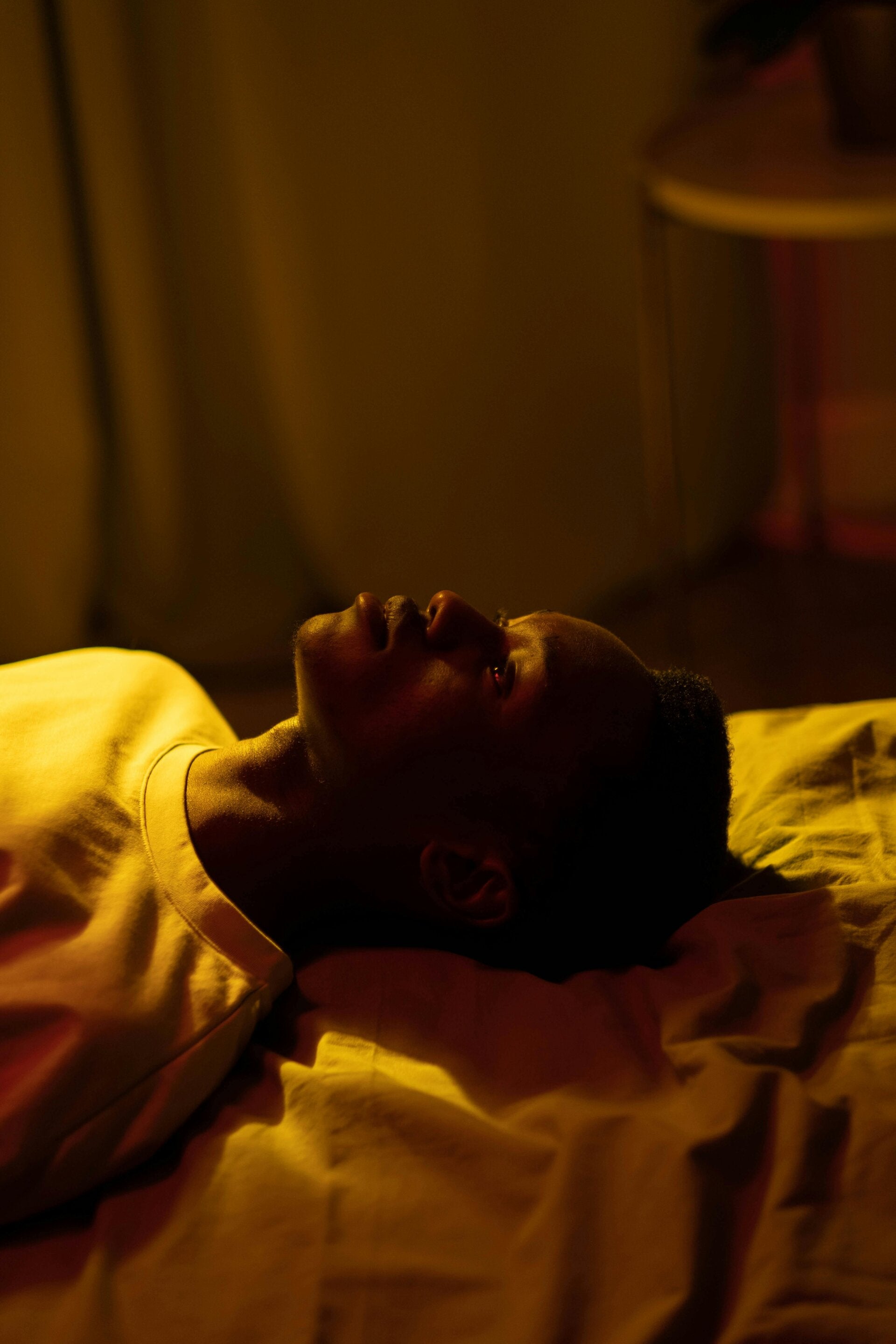

Make contact with me if you’re curious to explore a holistic somatic counselling approach which includes the Embodied Processing method (TCFH). I offer a sliding scale of fees and am happy to discuss how we can find a way together, to support your needs.
I am also offering a live call which will be recorded too, exploring this topic for the students and community at TCFH (The Centre for Healing) on April 2nd 2026.
Follow me:
Add comment
Comments