

We often think about boundaries as something we establish between ourselves and other people.
-
We say no
-
We limit contact
-
We block someone
-
We protect our time
-
We decide what behaviour we will and won't accept.
These are important boundaries. But there is another, quieter kind of boundary that is less visible to others and often more challenging to establish, this is the internal boundary.
An internal boundary asks: What am I allowing this person, situation or experience to occupy inside me?


Sometimes another person can take up an extraordinary amount of space in our lives without being physically present.
They can live in our thoughts, in our conversations, in the things we check, in the stories we tell ourselves about what might happen next.
We may not want them in our heads, we may not be speaking to them, seeing them or engaging with them directly, yet internally we remain in relationship with them. This month, I explore internal boundaries from two different perspectives.
For the person preoccupied with someone else: Can I stop reaching into someone else's life and return my attention to my own?
And for the person experiencing unwanted attention or intrusion: Can I protect myself appropriately without allowing someone else's attention to take over my inner life?
Either of these experiences invite us to become more conscious of where our attention is living.
When we are the one looking
Here’s a common scenario. When a relationship ends, our attachment to the other person doesn't necessarily end at the same moment. We may find ourselves checking an ex-partner's or family member's social media, wondering who they are seeing, looking at photographs, searching for information about their new relationship, comparing ourselves with the person who came after us, or wondering what their life looks like now. Sometimes we call this curiosity, sometimes we're looking for reassurance, sometimes we're looking for evidence that they are unhappy, sometimes we want to know whether they have moved on, sometimes we want to understand what happened, sometimes we are reaching for control over a person, and sometimes, beneath all of this, there may be a more vulnerable question: What does their life without me, mean about me?
Preoccupation after relational loss does not necessarily mean that someone is malicious. Attachment, grief, rejection and uncertainty can all keep our attention oriented towards someone who is no longer part of our lives. As practitioners, we can meet that vulnerability with compassion, but compassion for the feeling does not require us to reinforce the behaviour.
There is a difference between: "I am hurting and I keep wanting to look" and "Because I am hurting, I am entitled to keep looking."
The first invites curiosity, the second can become a boundary problem. Rather than simply telling ourselves to stop, we might become curious about what the behaviour is doing for us.
What am I hoping to find when I focus on them? How do I feel immediately before checking on them? How do I feel afterwards?
Does checking actually give me what I was looking for? What would I have to feel if I didn't know what was happening in their life?
Sometimes the behaviour isn't really about the other person, it may be an attempt to regulate our own uncertainty, maintain a connection, regain control, soothe rejection or postpone the painful work of accepting that something has ended.
The internal boundary becomes an invitation to return, not because the other person's life doesn't matter, but because it is not ours to inhabit.
When we are the one being watched
There is another side to this experience. Sometimes we are not the person looking, sometimes we are the person who feels watched.
Someone may repeatedly monitor our social media, seek information about us, contact us when we don't want contact, or otherwise intrude into our privacy. This is important to distinguish from ordinary relational discomfort.
If another person's behaviour becomes intrusive, threatening or persistent, there may be very real external boundaries that need to be established.
We may need to change privacy settings, limit access, document behaviour, seek professional advice or involve appropriate support.
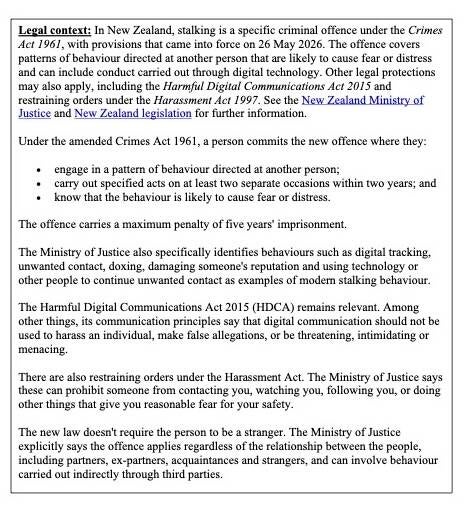
New Zealand law now specifically recognises stalking and harassment as a criminal offence, including patterns of behaviour carried out through digital technology. This means that internal boundary work should never be presented as a substitute for practical safety, documentation, professional advice or contacting Police where appropriate.
- Internal boundary work does not mean tolerating intrusive behaviour.
- It does not mean telling ourselves that we should simply stop caring.
- And it does not mean taking responsibility for another person's behaviour.
Sometimes the first question is 'How can I protect myself?' and then 'How can I protect my peace?'
Being watched or obsessed over can change the way we inhabit our own lives. We may begin wondering: Have they seen this? What will they think? What will they do next? Are they talking about me? Should I post this? Should I change that?
The person may not be physically present, yet their perceived presence or threat begins to interfere with our freedom. This is where internal boundaries can become important. Not because the intrusion isn't real or needing external boundaries in place, but because we don't want another person's attention to become the organising principle of our inner world.
The boundary-solution becomes, ‘I can take reasonable steps to protect myself without giving this person my entire attention, I can acknowledge what is happening, I can respond where a response is needed or ignore them, I can seek support when I need it, and I deserve privacy in my life’.



Protecting peace is not the same as ignoring danger
This distinction matters. There is a difference between feeling uncomfortable about someone's attention and experiencing behaviour that constitutes genuine harassment, stalking, threats or safety concerns.
If there is a legitimate safety issue, appropriate external action matters.
The internal practice comes alongside those measures; it does not replace them.
We might ask:
What actually requires my attention? What can I reasonably do about it? What is outside my control? What information do I genuinely need? Am I checking on them because it helps me feel safe, in control or because I am anxious?
There may be a point where checking no longer protects us or enables us to feel safe or in control, but rather continues to make us psychologically connected to the person who we want to have no/less influence over our lives.
The internal boundary is not "I don't care."
It may be: Whatever they think or do, my life to remains mine.
Where our attention lives
Attention is one of our most intimate resources. What we repeatedly attend to becomes psychologically significant. This doesn't mean we can simply choose not to think about something difficult. Trying to force a thought away often makes it louder, instead, we can notice 'There I am thinking about this again' and gently return to ourselves, back to the breath, back to the body, back to the person in front of us, back to our work, back to our nourishing relationships, back to our own lives.
This is not avoidance, this is the practice of discernment.
What belongs to me? What belongs to them? What am I carrying that isn't mine? What requires action? What requires acceptance? What deserves my attention? And what can I allow to remain outside the boundary of my inner world?
embodied boundaries
Our bodies may register a need for boundaries before our minds can articulate one.
- A tightening in the chest
- A clenched jaw
- A change in breathing
- A contraction in the belly
- A feeling of being watched
- A vigilance, restlessness, and an impulse to check, hide, defend, explain or withdraw.
These responses are information, we can pause, notice, feel, ask:
What is happening in my body?
What am I responding to?
What belongs to me here?
What doesn't?
And perhaps:
What would it feel like to take the action I need to take, and then return to the present moment?
For the person preoccupied with someone else, especially an ex-partner, the practice may be:
I don't need to keep reaching into their life in order to heal. I can return to mine.
For the person experiencing unwanted attention, it may be:
I can protect myself by not allowing another person's attention to enter my internal life.
Neither requires us to deny what has happened. Both are invitations to reclaim something precious… our own attention and self-awareness.

Returning to the body
How might we begin to recognise what is ours, and what we may have taken on from someone or something outside ourselves?
The body can offer clues. Notice what elicits contraction and what invites expansion; what feels tight, cold or agitated, and what feels grounded, spacious or soft. These sensations don't necessarily tell us what is true, but they can help us become curious about what is happening within us, where our attention is drawn, and what we might need.
You might experiment with the following phrases, noticing not just what you think about them, but how they land in your body:
My life is mine.
My attention is mine.
My peace matters.
Do you notice resistance, relief, discomfort, a sense of settling, or something else entirely? There is no right response. The invitation is simply to notice.
What happens when we bring these questions into an embodied session? What becomes available when we move a client beyond thinking about boundaries and begin to sense, explore and experience them in the body?
Coming home to our own lives
Internal boundaries are rarely dramatic. Sometimes they are simply the moment we put the phone down, the moment we stop checking, the moment we don't respond, the moment we notice ourselves rehearsing a conversation and choose to return to the present, the moment we recognise that another person's story about us belongs to them, the moment we take a practical step to protect ourselves and then allow ourselves to live again.
Perhaps the practice isn't: 'Stop caring' perhaps it is 'Care and come home to yourself'.
whether we are reaching towards someone else's life or trying to protect ourselves from someone else's intrusion, there is a common question beneath both experiences:
Where does my attention belong?
And perhaps one of the deepest forms of embodied practice is learning to recognise what is ours to hold, what is ours to release, and where we want to place our attention next.
Good internal boundaries may feel less like building a wall and more like being at home in yourself, and able to remain connected to others without losing contact with your own centre.
In embodied work, there isn't one correct bodily sensation that signifies a healthy boundary. It will vary between people and situations. But there are some qualities you might notice.
-
Grounded — feeling anchored, centred and connected to yourself.
-
Spacious — room to breathe, think and feel without being overwhelmed by others.
-
Soft but steady — relaxed without collapsing, appeasing or over-accommodating.
-
Self-connected — staying aware of your own needs, feelings, values and preferences.
-
Clear — sensing what is yours to carry and what belongs to someone else.
-
Choiceful — having space to pause and choose rather than feeling compelled to react, fix or explain.
-
Less entangled — remaining connected to others without becoming absorbed in their thoughts, feelings or choices.
-
Private and peaceful — feeling less exposed, monitored or pulled into someone else's world.
-
Open but discerning — being receptive to others while recognising your own limits.
-
Free to say no — allowing discomfort, guilt or sadness without automatically abandoning your own needs.
These sensations will vary. A healthy boundary doesn't always feel comfortable; sometimes it means staying grounded in yourself while experiencing difficult emotions. Embodied Processing practice builds the capacity for this.
in extreme circumstances if your boundaries not being respected - the law says
Add comment
Comments